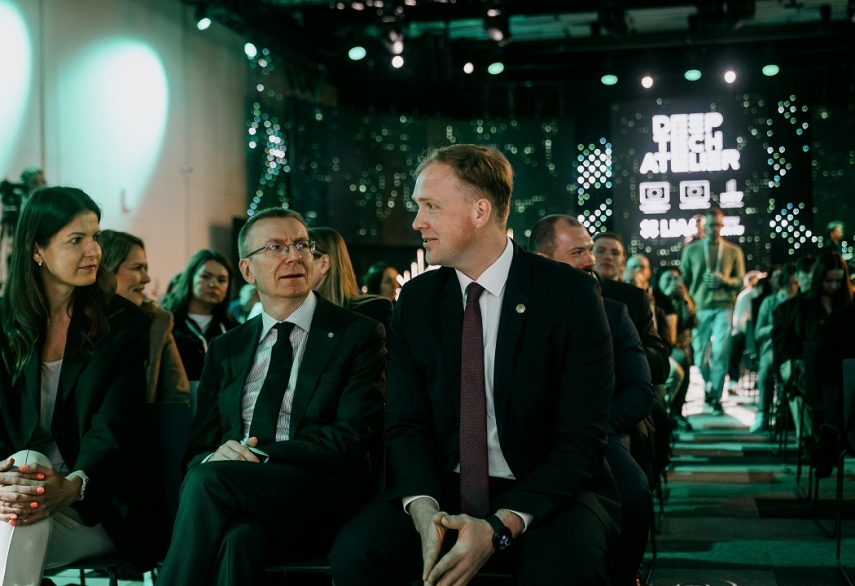
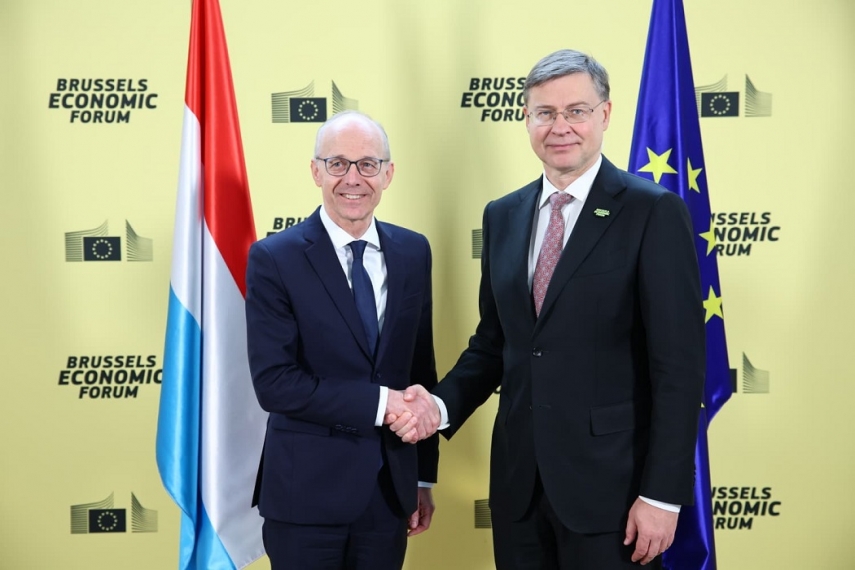
Photo: Luc Frieden, Luxembourg’s Prime Minister (on the left) with European Commissioner Valdis Dombrovskis (Brussels Economic Forum 2026)
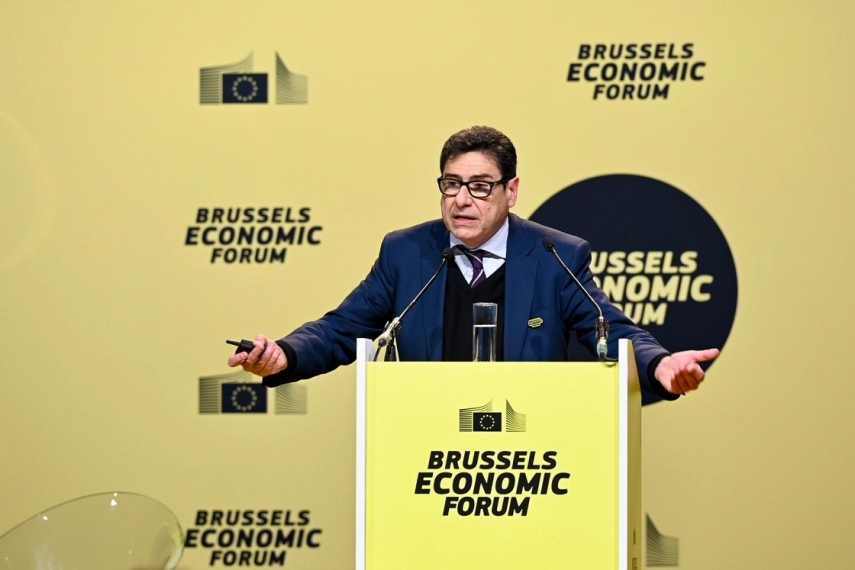
Photo: Nobel Prize-winning economist Philippe Aghion from France (Brussels Economic Forum 2026)
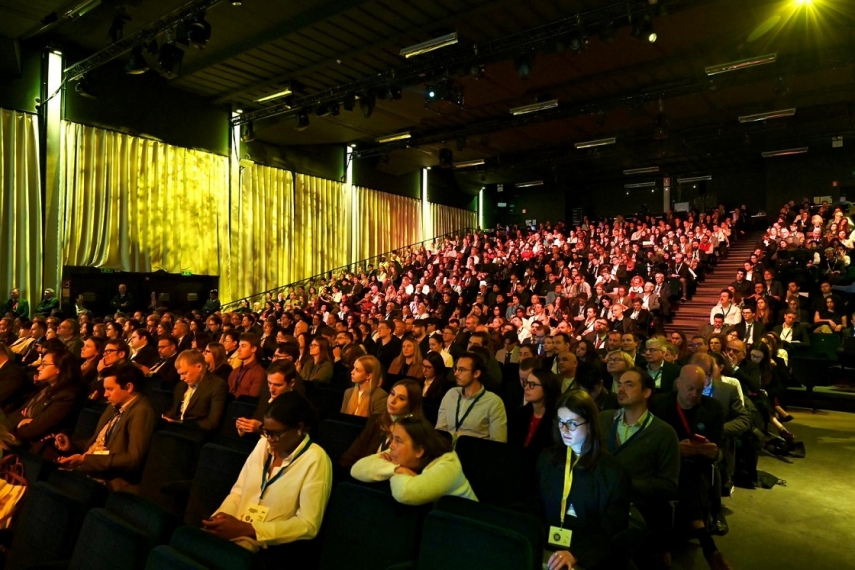
Photo: Brussels Economic Forum 2026
Artificial intelligence dominated this year’s Brussels Economic Forum, where European political leaders, economists and technology executives warned that the continent risks losing competitiveness, sovereignty and economic influence unless it accelerates innovation and investment. Speakers repeatedly argued that Europe can no longer afford to lag the United States and China in the global AI race. At the centre of the debate was the question of whether Europe can combine technological leadership with its democratic values, social protections and regulatory standards.
Luc Frieden: “Artificial intelligence is here to stay”
Luc Frieden, Luxembourg’s Prime Minister, urged Europe to move faster and think bigger in the global artificial intelligence race, warning that technological dependence could threaten the continent’s sovereignty, competitiveness and democratic values.
In the event, organised by the European Commission, Frieden said AI would fundamentally reshape economies and societies, making Europe’s response one of the defining political and economic challenges of the century.
“Artificial intelligence is here to stay…It will drive a fundamental transformation that will redefine our economies and societies in profound ways,” the PM emphasized.
Frieden rejected the idea that Europe must inevitably trail behind the United States and China in AI development.
“Europe is not destined to be third…We can lead – if we act together,” he said.
At the centre of his speech was the concept of “an AI of Europe, by Europe, for Europe”, which he said should reflect European values including democracy, rule of law and human dignity.
Frieden argued that Europe must avoid becoming dependent on foreign AI systems, warning that control over data, cloud infrastructure and AI models increasingly determines geopolitical power: “If the answers to these questions lie outside Europe, then so will our future.”
The Luxembourg leader stressed that supporting European AI champions should not be viewed as protectionism but as necessary competition policy. He called for a balance between innovation and regulation, warning against excessive bureaucracy that slows technological progress.
Frieden also highlighted Europe’s financing gap, noting that the continent holds around €12 trillion in household savings but channels too little capital into deep technology and startups. He called for pension fund reforms, simpler regulation and stronger investment frameworks to support AI companies.
“We must turn yesterday’s savings into fuel for tomorrow’s innovation.”
The prime minister said Luxembourg intends to position itself as a European AI platform through cross-border partnerships, sovereign cloud infrastructure and closer cooperation with European technology firms including Mistral AI and OVHcloud.
Commissioner Dombrovkis: “Europe is in a race for AI leadership”
Valdis Dombrovskis, the European Commissioner for Economy, Productivity, Implementation and Simplification, warned that Europe risks falling dangerously behind global competitors unless it moves faster to develop artificial intelligence, strengthen innovation and mobilise investment.
Opening the Brussels Economic Forum, Dombrovskis said AI is already reshaping economies, labour markets and geopolitics at unprecedented speed. In a light-hearted moment, he revealed that he had even used AI for inspiration while preparing his own speech.
“AI isn't just the future; it's rewriting the rules of our economy today, and Europe's next move will decide whether we lead the revolution or get left behind,” the underscored adding: “Europe is in a race for AI leadership. One that will define the 21st century.”
Dombrovskis argued that Europe failed to fully capitalise on the previous digital revolution dominated by US technology giants and warned against repeating the same mistake with AI. He noted that while the United States has produced six technology companies valued at more than €1 trillion, the European Union has produced none.
“We cannot afford to repeat the same mistakes with AI…Allowing an ‘AI gap’ to emerge with our international competitors and rivals would have grave consequences for our prosperity and security,” the Commissioner said, describing technological dependence as a growing geopolitical risk.
Despite the warnings, Dombrovskis argued Europe still possesses important advantages, including scientific expertise, industrial capacity and semiconductor technology. He highlighted that EU-based researchers produce 22 percent of global AI research papers, compared with 17 percent in the United States, while global chipmakers depend heavily on Dutch company ASML for advanced lithography systems.
However, he also warned that AI will create new cybersecurity and financial stability risks requiring closer policy coordination across Europe.
Nobel Prize winner Philippe Aghion: “Europe is falling”
Nobel Prize-winning economist Philippe Aghion delivered a stark warning to European leaders, arguing that the continent risks losing global relevance unless it embraces innovation, artificial intelligence and a radically different economic mindset.
Aghion said Europe had become trapped in excessive regulation, fragmented markets and weak support for breakthrough innovation, while the US and China race ahead in advanced technologies.
“Europe is falling,” he said, pointing to declining shares of high-tech patents and Europe’s inability to turn scientific research into globally dominant companies.
At the centre of his speech was the concept of “creative destruction” – the Schumpeterian theory that innovation replaces outdated technologies and drives long-term growth. Aghion argued that Europe has failed to create conditions allowing new firms to challenge established incumbents.
“Long-run growth is driven by a cumulative process of innovation where each innovator builds upon previous innovation…New innovations displace old technologies…Regulating a market economy is largely about how to manage these contradictions,” he said.
The economist sharply criticised Europe’s regulatory culture, saying competition policy had too often prevented industrial strategy instead of supporting it.
“In the name of competition policy, we precluded industrial policy. It was crazy,” the underlined.
He called for a European equivalent of the US DARPA model, combining AI, defence and long-term strategic investment. He also urged stronger venture capital markets, larger EU research budgets and greater tolerance for entrepreneurial failure.
Aghion described artificial intelligence as Europe’s next major opportunity, arguing that AI could significantly raise productivity and accelerate innovation if governments create the right conditions: “AI has enormous growth potential.”
However, he warned that excessive regulation could ultimately strengthen dominant technology giants instead of helping smaller innovators compete.
Despite his criticism, Aghion ended on an optimistic note, insisting Europe still possesses unique advantages rooted in democracy, education and social values.
“We have everything to become again a technological leader…I am a fighting optimist” – the speaker concluded.
Europe needs less or more regulation
Martin Sandbu, a Norwegian-born economist, author and journalist best known as the European economics commentator at the Financial Times, focused his Brussels Economic Forum remarks on the political and social consequences of AI, arguing that Europe should not treat regulation as an obstacle to innovation, but as part of shaping the kind of society Europeans want.
One of his key themes was that Europe should avoid copying the US model blindly. Instead, he argued Europe can develop a distinct AI framework rooted in democratic accountability, labour protections and social cohesion.
Sandbu also challenged the increasingly common argument that Europe simply needs “less regulation”. He suggested that smart regulation can itself become a competitive advantage if it creates trust and predictability around AI deployment.
Meanwhile, Isabelle Schomann, a French labour law expert, trade union leader and one of Europe’s most prominent voices on workers’ rights in the digital economy and AI regulation, argued that Europe’s AI strategy must remain centred on workers’ rights, democratic safeguards and social protections rather than focusing exclusively on competitiveness and deregulation.
She pushed back against claims that regulation is Europe’s main problem in the AI race. Instead, she argued that Europe’s regulatory model is one of its greatest strengths.
Schomann strongly defended the EU’s existing approach to data protection and AI governance, describing the GDPR and AI Act as global benchmarks.
“The GDPR was a milestone in the world,” she said, arguing that Europeans should not compromise fundamental rights in pursuit of technological leadership.
Europe cannot remain dependent on US
Jochen Hanebeck, chief executive of Infineon Technologies, argued that Europe still possesses strong industrial and semiconductor capabilities but is being held back by high energy costs, slow permitting procedures and fragmented regulation. He stressed that AI leadership will depend heavily on semiconductor supply chains and computing infrastructure.
Frank Karlitschek, founder and chief executive of Nextcloud, warned that Europe cannot achieve AI sovereignty while remaining dependent on US cloud providers and digital platforms. He called for greater use of open-source technologies and European cloud infrastructure, arguing that control over data increasingly represents geopolitical power.
Martins Kazaks, Governor of the Bank of Latvia, said AI should be viewed primarily as a competitiveness and productivity issue. According to Kazaks, Europe risks weaker long-term growth if it underinvests in AI and fails to modernise financial systems and capital markets.
Eva Maydell, Member of the European Parliament, argued that Europe must balance regulation with innovation. She warned against creating an environment in which startups leave Europe to scale elsewhere and called for faster decision-making and less bureaucracy.

Please enter your username and password.

2026 © The Baltic Times /Cookies Policy Privacy Policy